How to spot AI gibberish before your readers do
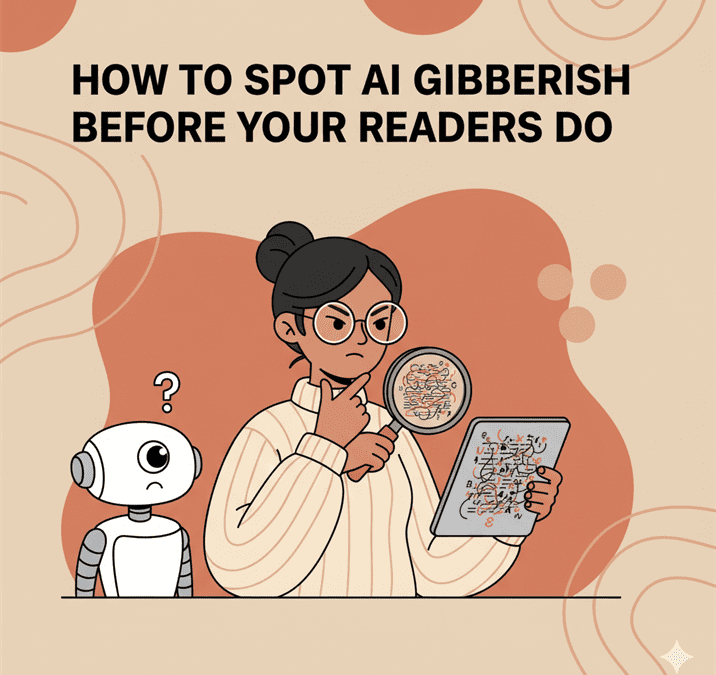
There’s a special kind of horror that comes from reading your own AI-generated paragraph and realising it sounds like an overconfident marketer describing a dream they half-remembered.
The words make sense. The sentences flow. And yet, somehow, nothing is being said.
That, dear editor, is AI gibberish, and if you don’t spot it before your readers do, you’re one “What does this even mean?” comment away from losing all authority.
The good news? Once you know what to look for, it’s surprisingly easy to detect.
The bad news? It’s everywhere.
Let’s fix that.
What “AI gibberish” really means
AI gibberish isn’t just nonsense words strung together (though that happens too).
It’s a more refined sort of nonsense, the kind that sounds logical, grammatical, even confident, but is ultimately hollow.
I like to break it down into three types:
- Semantic sludge: Text that sounds profound but carries the nutritional value of a rice cake. Example: “In today’s world, communication is more important than ever.” You don’t say.
- Stylistic static: Writing that’s too polished, too polite, too pleased with itself. Think “furthermore” every third sentence and the emotional range of a car repair manual.
- Logic drift: Sentences that start with a clear idea and wander off like a toddler in a supermarket. “AI helps writers save time by creating more thoughtful, human stories.” Wait, what?
The first step to spotting gibberish is learning to feel it. Your editor brain will itch when something looks right but sounds wrong.
Trust the itch.
Telltale signs in long-form content
Short AI blurbs can fool you. Longform content can’t hide for long. The mask slips after a few hundred words.
Here’s what to look for:
- Repetition: The same point explained three times in slightly different ways, as if the bot’s hoping one of them will land.
- Circular logic: Paragraphs that promise to explain something, only to redefine it.
- Keyword panic: Unnatural phrasing that smells like SEO desperation.
- Reset paragraphs: Every new section reads like the start of a new article (“In conclusion, let’s now discuss why…”).
- The filler epidemic: Clauses that could vanish without changing the meaning.
If you can cut 30% of the words and the paragraph still makes sense, congratulations, you’ve just deflated a sentence balloon full of hot AI air.
Style patterns that betray AI authorship
AI writes with suspicious balance. Every sentence feels engineered for symmetry, like someone obsessed with parallel parking.
Real writers are messier. I certainly am anyway!
Here are some stylistic red flags:
- Sentences that all share the same rhythm and length.
- Overuse of connective words (“additionally,” “in conclusion,” “moreover”) like an over-eager English student.
- Vocabulary that hovers safely in the middle. Not simple enough to be conversational, not daring enough to be memorable.
- Emotional neutrality. No bite, no charm, no personality, just sentences existing quietly, hoping you’ll move on.
AI rarely uses subtext. It says what it means, then says it again, then adds a polite summary of what it just said.
It’s the literary equivalent of being cornered by someone who keeps explaining their own joke.
The human editor’s instinct checklist
At this point, you might be thinking, Fine, but how do I train myself to spot this stuff faster?
I use what I call the F.A.C.T.S. test. It sounds serious, which makes people think I invented a framework.
- F – Flow: Does each paragraph lead naturally to the next, or does it feel like someone hit shuffle?
- A – Authenticity: Does it sound like an actual human with opinions or a press release generator?
- C – Consistency: Does tone, perspective or logic change halfway through?
- T – Truth: Are the facts real and checkable, or suspiciously vague (“Studies show…” Which studies?)
- S – Subtext: Does it understand the why behind what it’s saying or is it just performing relevance?
If a piece fails two or more of these, it’s time to grab your red pen (or the digital equivalent) and start de-botting.
Advanced detection tools (and their limits)
AI detectors like GPTZero, Copyleaks, and Originality.ai are useful but treat them as weather forecasts, not verdicts.
They can spot patterns of probability in text, but they can’t detect intent. They’ll flag Dickens as AI-written if you feed them enough adjectives.
Use them for triage, not judgment.
A 70% “likely AI” score doesn’t mean it’s fake, it means it sounds like everything else on the internet, which, to be fair, might be worse.
For editors, the real detector is still you. Your ear, your instincts, your allergy to phrases like “in today’s digital landscape.”
How to train your editorial intuition
Like any skill, AI-spotting improves with exposure. The trick is to read bad content on purpose. Seriously.
Compare unedited AI drafts with edited ones and start cataloguing patterns.
Ask yourself:
- Where does meaning collapse?
- What words appear too often?
- What’s missing emotionally?
Over time, you’ll develop a kind of AI accent recognition.
You’ll know the difference between “written by a person using AI” and “written by AI, reluctantly supervised by a person who gave up halfway.”
Turning detection into better writing
Here’s the beautiful irony. Learning to spot AI gibberish will make you a better writer.
When you start noticing filler, repetition and hollow phrasing, you also start cutting those things from your own work. I certainly did anyway.
You’ll find yourself writing leaner, sharper sentences and using AI more effectively because you’ll know what to fix before it breaks.
Editing AI isn’t just about cleaning up errors. It’s about reclaiming control of tone, pacing, and clarity.
You’re not fighting the robot, you’re training it to serve your style instead of drowning it.
The new literacy of AI editing
AI can write fluent nonsense. Editors give it meaning.
Spotting gibberish isn’t paranoia, it’s literacy. The ability to read a text and sense where the human intention drops out is what separates editors from everyone else pressing “Generate.”
So next time you catch an AI paragraph trying to pass itself off as thoughtful, don’t sigh, smile.
You’ve just proven your job isn’t going anywhere.
Besides, if AI ever truly learns to edit itself, we’ll all be retired on a beach somewhere, debating whether “semantic sludge” was a phase or a warning.
Bonus: Want a quick self-check tool?
Here’s a simple AI gibberish detector checklist you can turn into a Notion template or Google Doc:
| Check | Question | Why it matters |
| Flow | Do ideas build logically? | AI often resets context every few paragraphs |
| Tone | Does it sound emotionally flat? | Machines write feelings like they’ve only read about them |
| Density | Can you remove a third of the text without losing meaning? | Filler alert |
| Facts | Are claims sourced or generic? | “Studies show” is AI’s favourite lie |
| Readability | Do sentences vary in rhythm and length? | Real writers have musicality |
Print it. Share it. Pretend it’s proprietary. You’re welcome!