How to measure the ROI of AI-generated content
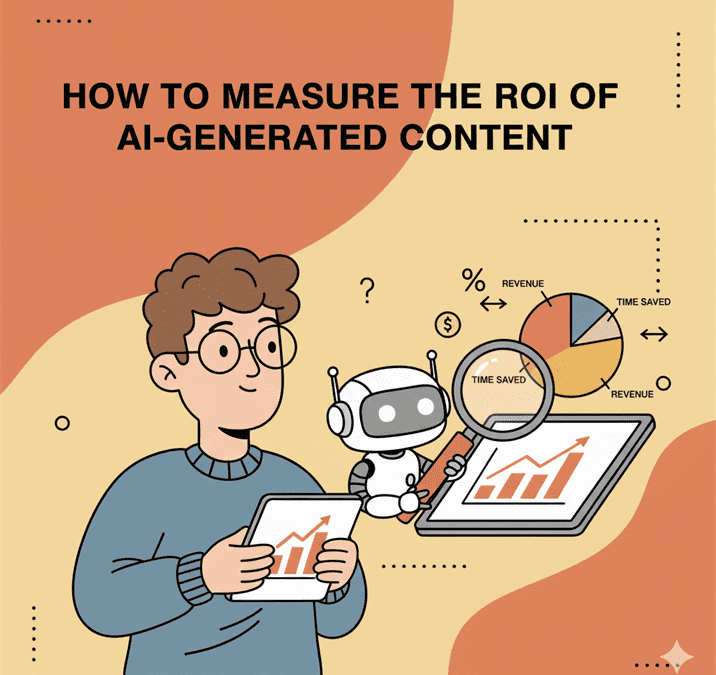
Let’s be honest, “AI ROI” sounds like something a marketing exec made up to justify an expensive software subscription.
It’s a slippery, shape-shifting concept that somehow manages to mean both “our content team is now twice as efficient” and “we bought a robot that occasionally writes like a confused fresher.”
Still, measuring the return on AI content is possible, and yes, it can make you look like the responsible adult in the room for once.
Why AI ROI is tricky but measurable
The trouble with AI ROI is that half of what it saves you isn’t money, it’s time, energy, and maybe sanity.
Traditional ROI maths doesn’t quite fit because you’re mixing hard numbers (production costs) with soft stuff (creative spark, morale, caffeine dependency).
But if you can measure output, cost and performance before and after using AI, you’ll start seeing patterns, good ones, hopefully.
To keep it simple, let’s use a formula marketers actually understand without needing a whiteboard:
ROI = (Gain from AI-assisted content – Cost of AI-assisted content) ÷ Cost of AI-assisted content × 100
Your “gain” can include traffic increases, improved conversions, or hours saved in content production.
Your “cost” includes tools, training, and the occasional therapy session after your AI writes in pirate slang for no reason.
Defining success metrics
Let’s talk metrics before someone says “KPIs” and ruins the vibe.
What actually counts as “success”?
- Traffic: Did your AI-assisted content bring more readers or did it confuse Google into silence?
- Conversions: Are visitors doing what you want, clicking, subscribing, buying, nodding approvingly?
- Time saved: How long does it now take to create a blog post compared to the dark, pre-AI era?
- Quality consistency: Is your tone of voice holding up or has your AI started sounding like a motivational fridge magnet?
Defining your own version of “winning” makes it easier to prove AI isn’t just a shiny toy.
Tracking cost savings vs human-only creation
Let’s do some friendly accounting (the fun kind, not the HMRC kind).
Compare how long a post takes to produce manually versus with AI assistance. Add hourly rates, tool costs and revision time.
If a 2,000-word article that used to take 8 hours now takes 4 and it performs the same or better, you’ve got ROI you can brag about without sounding too smug.
Here’s a worked example so you can actually see ROI in action:
Before AI: 10 articles per month at £300 = £3,000 total.
After AI: 18 articles per month at £200 effective cost = £3,600 value at £2,000 total cost.
ROI: (£3,600 – £2,000) ÷ £2,000 × 100 = 80%.
That’s not marketing fluff, that’s a tangible return. You’re producing more, spending less and, if you’re tracking properly, maintaining quality.
Just remember to factor in everything: AI subscriptions, editing time, prompt engineering, and tool integrations.
If you ignore those, your ROI might look great until someone from finance asks questions.
Measuring quality impact
Quality is the bit AI critics love to pounce on. You can’t just say, “It sounds fine to me.”
Measure engagement with hard data:
- Average read time
- Social shares and backlinks
- Comments or discussion volume
- Bounce rate trends
If your AI-aided pieces keep readers on the page longer or get more interaction, that’s your quality argument wrapped in a nice spreadsheet bow.
Also, track qualitative data like brand perception, internal feedback, or how often your boss stops asking, “Who wrote this?”
Tools for tracking AI-assisted workflows
There’s no shortage of tracking tools, Google Analytics, Ahrefs, Notion dashboards, time-tracking apps and the occasional chaotic Excel sheet.
The trick is consistency. Pick a system that helps you compare pre- and post-AI metrics easily.
You’ll want to track:
- Content production time per piece
- Edits and revisions required
- Engagement data over time
- Cost per piece
If you want to sound extra smart, say you’ve “instrumented your content workflow for ROI attribution.” Then enjoy the silence as everyone nods, pretending they understand.
The attribution challenge
Proving AI caused your improvement isn’t always clear cut. Algorithm updates, new campaigns, or better design could all skew results.
To isolate AI’s impact:
- Compare AI-assisted and human-only content over the same period
- Track content published dates versus traffic spikes
- Keep variables constant (topic difficulty, word count, publication timing)
Attribution is messy but acknowledging that complexity makes your analysis more credible than 90% of AI ROI blog posts out there.
Presenting ROI findings to stakeholders
You’ll need to translate all this into something that won’t make your boss’s eyes glaze over.
Frame it like this:
- “We reduced production time by 40% without lowering quality.”
- “Engagement held steady, even with increased output.”
- “We saved X hours per month, equivalent to Y cost reduction.”
Add one slide with charts that slope upward (the universal language of success).
Sprinkle in a confident “next steps” section, and people will start calling you “the AI person” in meetings.
Pitfalls to avoid
Not all AI ROI stays positive so watch for:
- Overproduction: More posts ≠ more traffic. Quality still wins.
- Editing creep: If AI saves time upfront but adds hours later, that’s negative ROI.
- Voice drift: Too much automation can dilute brand personality.
- Tool fatigue: Using five AI apps to do one thing kills efficiency.
ROI isn’t about speed, it’s about sustained improvement.
Turning AI from an expense into an investment
AI isn’t free and it isn’t magic, but it is measurable.
When you track time saved, output increased, and performance maintained or improved, you’re not just cutting costs, you’re proving value.
The trick is to treat AI as an extra team member who occasionally needs supervision but works cheap and never calls in sick.
So, next time someone asks, “Is AI content really worth it?” you can smile, open your spreadsheet and say, “Actually, yes, and here’s the data to prove it.”
Then bask in the brief, glorious silence of a meeting where you’ve already won.
For AI content that wins every meeting it attends, you know where to come.