From raw output to publish-ready: Designing an AI editing workflow that scales
There’s a universal lie in AI writing circles that no one admits to out loud: “The AI first draft is basically done.”
It isn’t. It never is.
If you’ve ever looked at a raw AI draft and thought, “Maybe it just needs a few tweaks,” you’ve either just begun your journey or you’ve temporarily forgotten the horror of reading paragraphs that confidently invent sources, repeat themselves like a parrot with memory issues and occasionally announce something that never happened.
But here’s the twist. AI drafts are still an incredible starting point, if you treat them properly.
The key isn’t just knowing how to edit AI, it’s knowing how to scale that editing without losing your sanity, your style or your weekend.
That’s where the AI editing workflow comes in.
Not a mythical, one-click miracle. A system. A process. A series of organised steps that turn “raw output” into something your readers might actually trust.
The illusion of “AI-ready” content
We’ve all been there. You ask AI to write a blog post and think, “That’s not bad.” Then you reread it and realise it’s full of words that sound right but say absolutely nothing.
Like a TED Talk scripted by a thesaurus.
I have spoken about this before so I won’t bore you with it again, too much anyway.
AI doesn’t know what “done” means. It knows what “text” means. That’s not the same thing.
Raw AI output is often grammatically fine but emotionally hollow, logically inconsistent, or painfully generic.
It’s like getting a student essay that’s 70% correct, 20% filler, and 10% confidently wrong.
So before we scale anything, we need to stop pretending the machine has instincts. It doesn’t. That’s our job.
Step one: Define what “ready” actually means
Before you build a workflow, you need to decide what you’re optimising for.
What does publish-ready mean to you?
Is it just grammatically correct, or does it have to sound like your brand? Does it need to be fact-checked, SEO-friendly, emotionally intelligent, or all the above?
If you don’t define “done,” AI will assume “done” means when it stops typing.
For me, “ready” usually means a piece that’s clear, factually sound, aligned with voice and doesn’t make me cringe halfway through.
Your definition might differ, but whatever it is, make it explicit, because scaling chaos just gives you more chaos.
Step two: Separate creation, editing and review
This is where most AI workflows collapse, we try to do everything at once.
One minute you’re prompting, the next you’re fact-checking, then you’re fixing tone while pretending it’s all efficient.
It isn’t.
The scalable approach is to separate the stages.
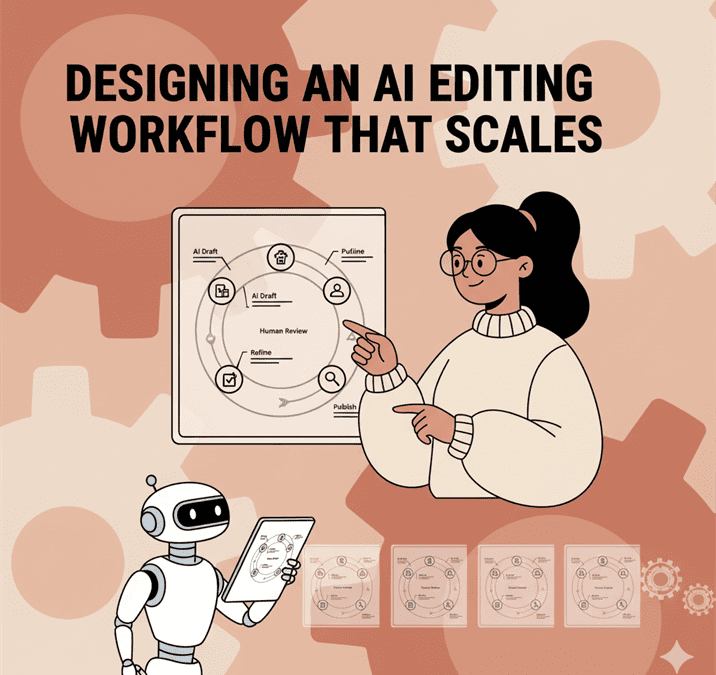
- Stage 1: Raw generation. Let AI create freely. Don’t edit mid-flow. Think of this as the brainstorming stage where bad ideas are allowed to exist.
- Stage 2: AI editing. Use a secondary pass or a separate prompt to clean structure, tighten flow and identify logical gaps. It’s still AI work, just tidier.
- Stage 3: Human editing. This is the grounding stage. Fix nuance, add voice, trim excess and re-inject humanity.
I call this the AI-AI-Human sandwich. The first AI does the grunt work, the second AI cleans up and the human adds flavour.
Skip the last layer and the sandwich tastes like buttered data.
Step three: Build templates and repeatable steps
Once you’ve done this a few times, you’ll realise your workflow is mostly repetition, the same instructions, the same edits, the same voice reminders.
Perfect. That’s where templates save you.
Create reusable prompt frameworks for each stage.
For example:
- One prompt template for research and outline generation.
- One for editing structure and length.
- One for tone calibration.
- And a final checklist for factual or SEO review.
It’s like giving your AI a to-do list instead of a creative brief. You don’t need to reinvent the wheel every time, just make sure the wheel’s not elliptical.
I recommend keeping these separate as not every piece of content will need every prompt.
You can even assign AI “roles.” Editor, proofreader, stylist, fact-checker.
That might sound silly, but giving your AI defined jobs keeps it focused. Otherwise, it’ll try to do everything and end up doing none of it well.
Step four: Teach tone, don’t just test it
Voice consistency is the silent killer of scalable content.
You think everything sounds fine until you publish five posts that all feel like they were written by slightly different people who met at a networking event once.
The fix? Stop relying on post-editing tone checks and start teaching tone in the workflow itself.
Feed your AI examples of your writing style. Include system prompts that define your voice in detail, pace, phrasing, humour, point of view.
The more specific you are, the more consistent the results.
If you can’t describe your tone clearly, that’s your first assignment. Try writing your “voice guidelines” as if you were introducing yourself to a stranger:
“I write like someone who knows their stuff but doesn’t take themselves too seriously. I use humour sparingly, honesty liberally and never sound like I’m trying to sell a cloud subscription.”
When you can define that, you can scale it.
Step five: Automate the boring, not the brilliant
The best part of a good AI workflow is offloading drudgery. Formatting, grammar, metadata, internal links, automate all of it.
But never automate judgement.
AI can catch typos, but it can’t tell when your metaphor collapses halfway through. It can rewrite a paragraph, but it can’t decide if it feels right.
Let it handle consistency checks. Keep the storytelling, humour and subtlety for yourself. Those are the parts that make readers stay.
Step six: Measure quality, not quantity
If you can’t measure it, you can’t scale it. But measuring the wrong thing can ruin everything.
Don’t judge success by how many posts you pump out. Measure how publishable those posts are.
Track editing time per piece, factual error rates and reader engagement.
I once tested adding an AI edit layer before human review. Editing time dropped by 40%, but average engagement actually rose because consistency improved.
Scaling didn’t mean sacrificing quality, it meant spending my time where it mattered most.
Speed is intoxicating but if you triple your output and double your cleanup time, you’ve automated yourself into trouble.
Step seven: Find the human-machine sweet spot
The real win in AI editing isn’t replacing editors. It’s freeing them.
Let AI handle the predictable so you can focus on the precise. Let it handle polish so you can focus on point of view.
AI can structure, polish and streamline. But it still can’t decide what’s worth saying. That’s your job. That’s where the craft lives.
Once you stop fighting the machine and start managing it, editing becomes less like triage and more like direction.
You become the showrunner, not the script doctor.
From chaos to craft
A scalable AI editing workflow isn’t about doing more. It’s about doing better at scale.
Define what “ready” means. Separate creation from editing. Template everything repetitive. Teach tone. Automate the dull stuff. Measure what matters.
Do that, and you’ll go from cleaning up AI messes to orchestrating a genuine editorial process that produces consistent, credible, human-sounding work.
Because the end goal isn’t “AI-assisted writing.” It’s editorially guided intelligence.
And when it all clicks, you’ll look at your computer, see ten pieces waiting for review and think, “Huh. That’s quite manageable.”
Then you’ll pour coffee, smile, and remember the old days when every draft was a small existential crisis in 2,000 words.
If all that sounds great but not for you, I can help.