Autoplay media with sound is a crime against context
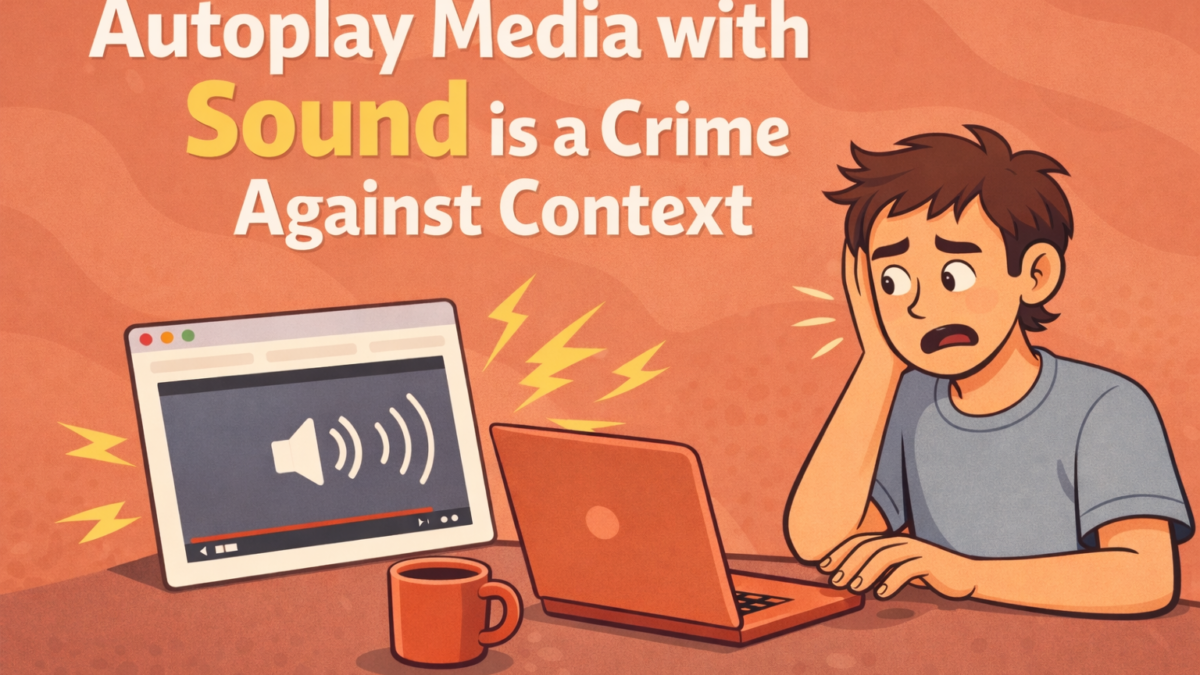
Let me set the scene.
You’re in a quiet office. Or a café. Or on a train where everyone has silently agreed to pretend not to exist.
You open a browser tab. You’re calm. Curious. Optimistic.
Then a video starts shouting at you.
No warning. No countdown. Just sudden, confident noise bursting into a space that absolutely did not consent to it.
Your shoulders tense. Your heart rate jumps. Your hand scrambles for the mute button like you’re defusing something.
Anyone else nearby now thinks you’re the type of person who watches loud videos in public.
You didn’t choose this. The publisher did.
And you will remember that.
Autoplay with sound doesn’t break UX. It breaks trust
People often frame this as a usability issue. It’s not. It’s a social violation.
When you autoplay audio, you’re not just interrupting attention. You’re barging into the user’s physical environment.
Their office. Their home. Their commute. Their carefully maintained illusion of having their life together.
The browser tab didn’t ask permission. The site didn’t signal intent. The sound just arrived, loud and confident, like it owned the place.
That moment matters more than most publishers realise.
Because users don’t think, “This site made a poor design choice.” They think, “I regret opening this.”
That feeling sticks.
The cortisol spike nobody budgets for
Here’s the part that never shows up in analytics.
Autoplay with sound creates a physiological response. A real one.
Sudden noise triggers stress. It’s instinctive. Your body reacts before your brain has time to reason it out.
So, while your video is heroically introducing itself, the user is:
- Searching for the mute icon
- Slamming volume keys
- Closing the tab entirely
- Feeling mild but genuine resentment
By the time calm returns, the content has already lost.
You cannot win back someone you startled.
“But it increases engagement” is not the defence you think it is
Yes, autoplay can increase video starts. It can inflate certain metrics. It can make charts look better in a meeting.
None of those charts measure irritation.
None of them capture the moment someone silently decides never to trust your site again.
Engagement that begins with annoyance is not engagement. It’s hostage-taking. You have their attention because they’re trying to escape.
That’s not a relationship you build anything on.
I write scripts all the time. I put my heart and soul into them and it hurts me to the core when the client proudly shows me the published video and it’s set to autoplay with audio.
Sound assumes too much
Autoplay with sound makes a lot of assumptions.
- It assumes the user is alone.
- It assumes they want audio right now.
- It assumes your content is worth interrupting their environment.
- It assumes urgency where none exists.
Most of those assumptions are wrong most of the time.
People browse in shared spaces. They multitask. They open tabs to skim, save, or read later.
Audio is opt-in by nature. Treating it as default is arrogance disguised as confidence.
Muted autoplay is a different conversation
To be clear, autoplay itself isn’t the villain. Autoplay with sound is.
Muted video that waits for consent is fine. Sensible, even. It lets people choose the moment. It respects context. It acknowledges that sound is intimate.
The moment you require a click to hear audio, everything changes. The user is now participating, not defending themselves.
Consent fixes a lot.
The emotional math is brutal
Let’s do the quiet arithmetic.
Best case scenario: Someone actually wanted the sound and didn’t mind.
Worst case scenario: You embarrassed them in public and they now associate your brand with stress.
The upside is mild. The downside is permanent.
That’s a terrible trade.
People don’t complain. They leave
Most users won’t tweet about it. They won’t email feedback. They won’t write an angry review.
They’ll just close the tab.
Silently. Efficiently. Forever.
You’ll see bounce rates. You’ll blame content. You’ll tweak headlines. You’ll never realise the damage was done in the first half-second of unexpected noise.
Respect the room
Good digital experiences understand something simple.
You’re not just designing for a screen. You’re designing for a room.
A train carriage. An open-plan office. A living room at midnight.
Autoplay with sound ignores the room completely. It acts like the user exists in a vacuum with headphones on and nothing better to do.
They don’t. They never did.
A small choice with outsized consequences
Turning off autoplay sound feels minor. Almost trivial. One toggle. One setting. One line of thinking.
But it sends a clear message.
- “We respect your environment.”
- “We won’t surprise you.”
- “You’re in control here.”
Those messages matter more than any forced video view ever will.
If your site ever makes someone frantically hunt for the mute button, you’ve already lost the moment.
And moments are the only thing users actually remember.