


A corporate Carol: Three ghosts, one warning and a company that should have known better
 By Jamiek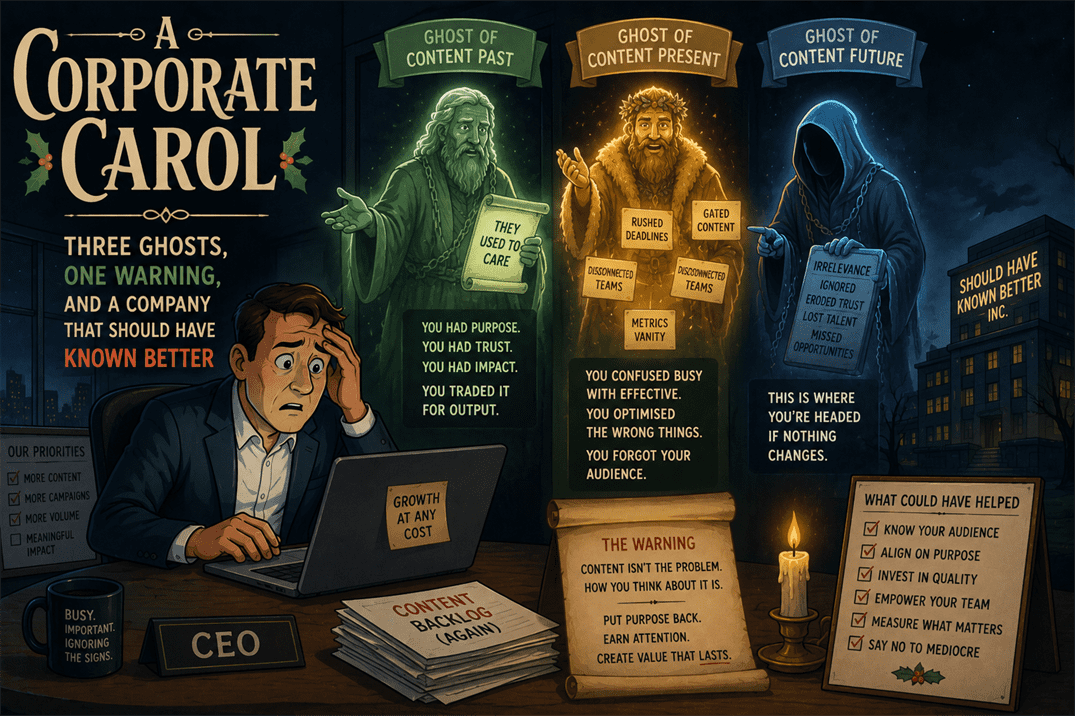
I’m going to tell you a story. The names have been changed to protect the guilty, the oblivious and the middle managers who genuinely believe that a town hall with a slide deck counts as communication.
It starts, as most cautionary tales do, with good intentions and a very exciting shared vision.
The ghost of working life past
Picture a company. Let’s call it Thunderclap Thrust. Small, scrappy, building something from nothing in a market that was ramping up fast.
The kind of early-stage energy where everyone is slightly underpaid and nobody particularly cares because the work is good and the people are interesting and there is, against all reasonable expectation, something genuinely alive about coming to work.
The CEO was there. Actually there. In the meetings, in the conversations, in the Slack threads where the thinking happened before it became a decision.
You could disagree with him in a room full of people and something might actually shift as a result.
That’s rarer than it sounds. Most leaders perform openness. This one had it.
Town halls were worth attending. Not because attendance was monitored or the slides were particularly good, but because something unpredictable might happen.
Someone from customer support might say something that changed how the product team thought about a feature.
A developer might push back on a brief and turn out to be right. The CEO might answer a difficult question honestly instead of repackaging it as a vision statement.
The creativity in that building wasn’t just in the people whose job titles contained the word “creative.” It was everywhere.
It lived in the arguments. In the Thursday afternoon conversations that wandered somewhere nobody had planned to go.
In the friction between people who thought differently and were, crucially, still talking to each other.
That interest, that lateral, generous, slightly chaotic human interest, was the company’s best asset.
The ghost of working life present
Things change. Companies grow. Somewhere along the way, efficiency and profit became the goals.
Not a goal, the goals. The two things every decision got measured against.
And AI, arriving at exactly the right moment with exactly the right promise, became the instrument of that efficiency.
The tools came in and the tools were good and the output went up and the headcount conversation changed.
Meetings still happen at Thunderclap Thrust but the energy in them is different now.
It’s flatter, more transactional, shaped by the knowledge that the outcome has probably already been decided and the meeting is largely a notification exercise in Zoom.
The CEO appears occasionally, in the way that weather appears, present for a moment, then gone, having not particularly interacted with anything much.
Town halls have a particular quality now. They are comprehensive. They cover the quarter’s metrics, future priorities, the values (there are values, presented on a slide, in a font that suggests confidence).
People attend. People wait, with the particular patience of people who have somewhere else to be, for the moment it ends.
The spontaneous conversation has gone quiet. Not because anyone banned it, but because the conditions for it have slowly been removed.
Teams are siloed in the way that teams become when collaboration isn’t actively valued, not forbidden, just not rewarded, not modelled, not happening.
Asking someone from another department for help carries this faint social weight now.
The sense that you’re wandering off the reservation, that your request will arrive as an inconvenience rather than a conversation.
And the roles. The roles are being replaced, gently, persistently, in the language of “optimisation” and “resource allocation” and “AI-assisted workflows.”
A task that took a person a day now takes a tool twenty minutes. The tool produces the output. The output is checked. The output is used.
What’s gone, what nobody has written on a slide, is the thinking that used to happen during that day.
The reading around the subject. The instinct that said this direction is wrong, actually, let me ask a question before I start.
The writer who’d worked on twelve similar campaigns and knew, in their bones, what wouldn’t land and why.
The designer who’d sat on enough customer calls to have opinions that weren’t in any brief.
That knowledge doesn’t transfer to a prompt.
It accumulates in people over years, through failure and feedback and the specific education of caring about something long enough to get good at it.
When the people go, it goes with them. The tool doesn’t mourn it. The tool doesn’t know it existed.
The ghost of working life yet to come
I want you to imagine Thunderclap Thrust in five years. Not a collapse, nothing so dramatic. Just a slow, dignified hollowing.
The people who left first were the ones the company could least afford to lose, which is almost always how it goes.
The awkward ones. The ones who asked questions that didn’t have efficient answers. The ones who took longer because they were doing something that resisted being done quickly and could articulate why.
They got tired of making that case.
Some of them are doing genuinely interesting work elsewhere. They’ve taken their knowledge, their instincts, their years of accumulated creative judgment and they’ve applied it somewhere that still wants it.
What remains is a management layer, a set of tools and a shrinking group of people whose primary function is to operate the tools and approve the output.
The output is, to be clear, fine. It is produced at scale, on time, within budget. It meets the brief. It satisfies the metrics.
It has no soul, but that’s not in the brief.
The products look like the products. The content reads like the content.
If you don’t know what Thunderclap Thrust used to feel like from the inside, you might not notice anything is missing.
But the customers, somewhere in the part of them that responds to things made by people who cared, have noticed something.
The feedback has a flatness to it. The loyalty numbers are moving in a direction that requires explanation every quarter. The new things feel less surprising than the old things.
Innovation has stalled in the particular way that innovation stalls when there’s nobody left who’s allowed to be wrong out loud.
When every idea has to arrive pre-approved, pre-validated, pre-stripped of the rough edges that usually meant something interesting was in there.
When the process of making something has been so thoroughly optimised that the making itself has lost the unpredictability that made some of it extraordinary.
What Scrooge did next
In the original Christmas Carol, Scrooge wakes up on Christmas morning, buys the goose, gives Bob Cratchit a raise and spends the rest of his days being the most delightful man in London.
The transformation is the point. He sees what he’s become, sees where it ends, and chooses differently.
The version I watched didn’t end like that.
The town halls kept happening. The tools kept arriving. The decisions kept coming from above with the texture of documents.
The people who made the place worth working in left gradually, then quickly, then the company stopped noticing because there was no one left who remembered what they’d been.
I left. A number of the best people left. Others are trying to leave.
The company is still there, still producing output, still hitting targets, still optimising.
I don’t think it’s building anything great or truly groundbreaking anymore. I think it’s maintaining something.
There’s a difference and the difference is everything.
What this is actually about
This isn’t a piece about AI being bad. I use AI tools regularly and they’re useful and anyone who performs vague outrage about them while quietly using them in private is almost as tiring as the true believers who’ve decided that creativity was always just pattern-matching anyway.
This is about what a company gives up when it decides that human creativity is a cost to be reduced rather than an asset to be protected.
When the goal shifts from building something that matters to producing something efficient and profitable above everything else.
When the thing that made the work worth doing, the people, the lateral thinking, the generous chaos of smart humans being interested in each other, gets classified as overhead.
Creativity is not a feature. It’s not a prompt. It doesn’t live in a tool or a template or a workflow.
It lives in people who have been given the time, the trust and the genuine human contact with other people to develop it.
Take those things away carefully enough and you won’t notice what you’ve lost until the gap is too wide to close.
The ghost of working life yet to come is not inevitable. But it is, for a lot of companies right now, the direction of travel.
If this landed somewhere that felt familiar, that’s probably worth sitting with. And if you want to talk about what good content looks like when it’s built around actual human judgment rather than the absence of it, you know where to find me.

 Oct 08, 2026
