So you want to get into marketing?
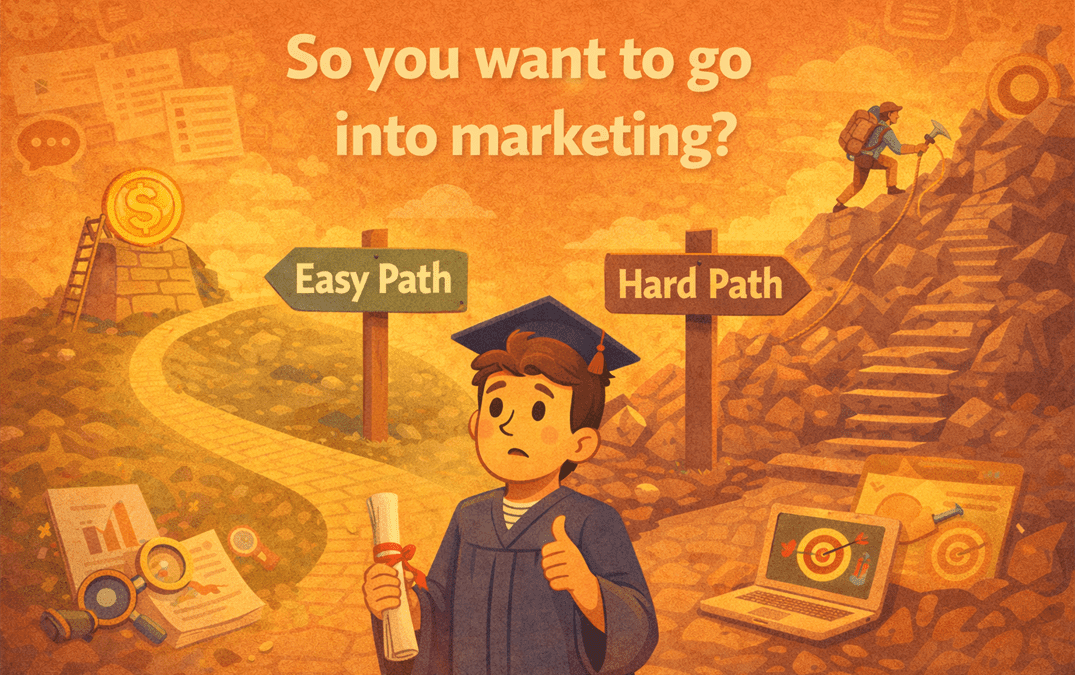
I was asked the other day, “What advice would you give someone thinking of entering marketing straight from university?”
I paused.
Not because I think marketing is doomed. It isn’t. It’s very alive. Loud. Busy. Slightly deranged at times.
I paused because the advice I’d give now is different from what I’d have said ten years ago.
Back then? I’d have said, “Jump in. Start a blog. Learn some SEO. You’ll be fine.”
Now? I’d say, “Jump in but bring a ladder as the low-hanging fruit is gone.”
Let’s talk.
First: Marketing is still lucrative
Let’s clear up the doom narrative.
Marketing still:
- Drives revenue
- Builds brands
- Creates leverage
- Pays very well at the top end
Content, in particular, is still a serious asset. Businesses need visibility. Visibility needs words, ideas, positioning, narrative.
AI hasn’t killed content. It’s just flooded the internet with “good enough.”
And that changes the entry game.
The era of easy wins is over
There was a golden window where you could:
- Start a blog with light effort
- Rank for niche terms
- Build an audience organically
- Monetise with basic funnels
That fruit has been picked. Eaten. Turned into a smoothie. Posted on Instagram.
Now?
Competition is global. AI can generate content instantly. Brands have in-house teams. Barriers to entry are lower, but expectations are higher.
That doesn’t mean you shouldn’t enter marketing. It means you need a better plan.
Advice number one: Pick a lane sooner than you think
I wrote recently about how experience compounds and how the general marketer is under pressure.
Here’s the truth.
If you graduate and describe yourself as: “Passionate about digital marketing, social media, branding, analytics and storytelling.”
You’ve also described 400,000 other people.
Instead, try this:
- Technical SEO for ecommerce
- Long-form B2B SaaS content strategy
- Paid media for local service businesses
- Conversion copy for high-ticket offers
Specificity feels risky early on but it’s really not.
Depth builds faster when you commit. You can always expand later.
Advice number two: Learn business, not just marketing
This is where most newcomers trip.
They learn:
- Tools
- Platforms
- Trends
- Tactics
They don’t learn:
- Profit margins
- Customer acquisition cost
- Lifetime value
- Sales cycles
- Cash flow
Marketing is not vibes and visuals. It’s economic engineering.
If you understand how a business actually makes money, you become instantly more valuable than someone who just knows how to schedule posts.
When I say adapt or die, this is what I mean.
Adapt toward business literacy.
Advice number three: Use AI, but don’t hide behind it
You will use AI. Everyone does. If you don’t, you’re choosing difficulty for sport.
But here’s the trap.
If your entire skillset is, “I can write a decent prompt,” you’re replaceable.
Instead:
- Study why certain content performs
- Analyse structure
- Rewrite AI drafts to improve persuasion
- Learn how to fact-check properly
- Develop editorial judgement
AI can draft but it can’t decide what matters. If you become the person who decides what matters, you win.
Advice number four: Build proof, not opinions
University gives you theory but the market wants evidence.
Start something.
A niche newsletter. A micro-site. A YouTube channel. A case study series. Volunteer to run ads for a small business and document results.
Even small numbers matter if they’re real.
“Grew traffic from 0 to 1,000 monthly visitors” beats “Studied digital strategy frameworks.”
Marketing is an applied discipline. Apply it.
Advice number five: Get comfortable with discomfort
Marketing changes constantly. Algorithms shift. Platforms rise and fall. Privacy rules evolve. AI improves.
If you crave certainty and predictability, you’ll struggle.
If you enjoy learning, iterating, experimenting, failing quietly, then adjusting, you’ll thrive.
This is why experience becomes so powerful over time.
You build scar tissue. You stop panicking at every headline that says “SEO is dead” for the 47th time.
You learn to tune all that out.
You can’t shortcut it entirely, but you can accelerate it by exposing yourself to real projects early.
Advice number six: Develop a skill that’s annoying to learn
This is my slightly mischievous rule.
Pick something that most people avoid because it’s too hard.
- Technical analytics
- Deep research
- Long-form narrative structure
- Advanced CRO
- Data storytelling
If it’s uncomfortable, complex, or slightly boring at first, good. That’s where defensibility lives.
Low-hanging fruit is crowded. High-branch fruit requires effort, which means fewer climbers.
So should you enter marketing?
Yes, but not casually. Marketing isn’t a side hustle playground anymore. It’s a competitive profession.
The upside is huge. The demand is real. The leverage is incredible.
But the bar is higher.
- You cannot just be enthusiastic. You must be skilled.
- You cannot just be creative. You must be strategic.
- You cannot just be “into social media.” You must understand systems.
If that excites you, welcome!
If that sounds exhausting, that’s okay too.
Better to know now than after three unpaid internships and a personal brand built on vague motivational quotes.
A final word from someone who has been around the block
If you’re entering marketing, you have an advantage I didn’t have.
You’re starting in an AI-native era. You can integrate tools from day one. You can learn faster. You can test ideas quickly.
Just don’t confuse speed with mastery.
The fruit is higher now. Climb anyway. It’s still worth it.
If you’re looking for a combination of youthful energy and hard-won experience, let’s talk.