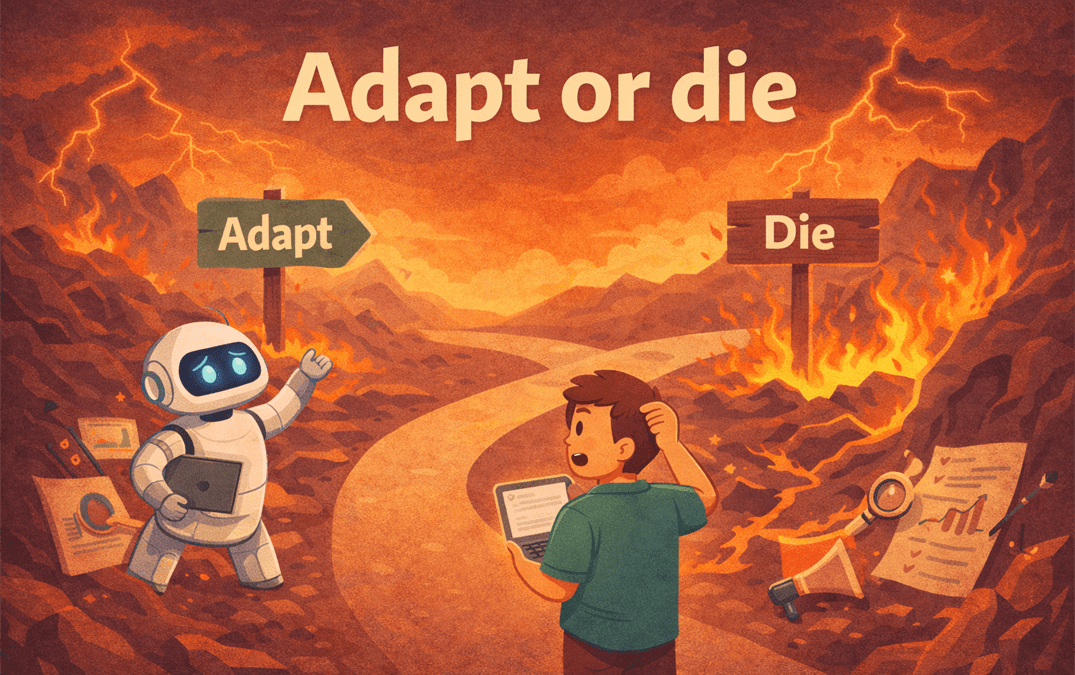
Adapt or die: The uncomfortable future of the general marketer
I tried to write this gently, I really did.
I started with something soothing like, “Marketing is evolving.” Then I deleted it because that sounds like a corporate meditation app.
Let’s say it plainly.
Marketing is alive and kicking. It’s energetic. It’s profitable. It’s still one of the most powerful levers in business.
But the era of the general marketer is under serious pressure.
Not dead. Not extinct. Just… standing in a very windy field while AI sharpens its tools.
And if that sentence made you sit up slightly straighter, good. That means you care.
Marketing is not dying. It’s specialising
First, let’s calm the apocalypse talk.
People still need:
- Positioning
- Messaging
- Demand generation
- Conversion optimisation
- Brand storytelling
- Community building
Businesses still need revenue. Revenue still requires attention. Attention still requires strategy.
So no, marketing isn’t going anywhere.
What is changing is who thrives.
For years, you could build a career as a capable generalist. You knew a bit of SEO, a bit of paid ads, a bit of email, a bit of content. You could spin up campaigns, write decent copy, interpret analytics dashboards.
That was enough. I know, I did it for years.
Now AI does the “bit of everything” surprisingly well.
The squeeze on the generalist
AI is excellent at:
- Drafting serviceable copy
- Generating ad variations
- Producing content outlines
- Analysing performance trends
- Repurposing across platforms
If your value proposition is “I can do a bit of everything reasonably well,” you’re competing with a machine that works 24 hours a day and doesn’t need snacks.
That doesn’t mean you’re obsolete, it just means you need depth.
The general marketer used to win on breadth.
The future marketer wins on mastery.
Why specialists are quietly smiling
The people who go deep are not panicking.
- The technical SEO who understands crawl budget and site architecture at a granular level.
- The conversion copywriter who knows how to shift emotional state line by line.
- The analytics expert who can design measurement frameworks, not just read dashboards.
- The brand strategist who understands cultural nuance, not just trending audio.
AI can assist all of them but it cannot replace the depth of judgement they can provide.
Specialists are harder to swap out because their skill isn’t surface-level execution. It’s layered understanding.
And layered understanding takes time and effort to master.
“Adapt or die” sounds dramatic
I know. It sounds like a line from a motivational poster featuring a wolf on a mountain.
But the principle holds.
Digital marketing has always rewarded adaptation.
Remember:
- The shift from desktop to mobile
- The rise and fall of organic reach
- The explosion of paid social
- The privacy changes that reshaped targeting
- The rise of short-form video
Every phase thinned out people who refused to adjust.
AI is another phase. A bigger one.
The difference now is speed.
Change cycles are shorter. Tools are smarter. Competition is global by default.
Standing still is riskier than ever.
The myth of “AI will handle it”
There’s a seductive idea floating around that AI will handle the hard bits.
That you can:
- Automate strategy
- Prompt your way into positioning
- Generate authority on demand
AI can accelerate execution but it can’t decide what matters.
It can’t choose which audience to ignore.
It can’t sense when a market is fatigued by a narrative.
Those decisions require context, taste and human experience.
Which brings us back to the uncomfortable truth.
If you want to stay relevant, you must become someone whose judgement matters.
Not just someone who can operate tools or work a prompt.
Deep knowledge is the new insurance policy
In a world being taken over by automation, depth becomes our defensive strategy.
Ask yourself:
- What do I understand at a level most people don’t?
- What problems can I solve that AI cannot diagnose alone?
- Where do I have pattern recognition built from repetition?
If your answer is “I can write a decent blog post,” that’s not enough anymore.
If your answer is “I understand how search intent maps to revenue for SaaS businesses in competitive niches,” now we’re talking.
Depth makes you less interchangeable, and in a market flooded with interchangeable output, that’s everything.
It’s tough out there. Let’s not pretend otherwise.
This is the part where I resist the urge to sugarcoat it.
It is tougher now.
Entry-level marketing roles are shifting. Expectations are rising. Tools are compressing timelines.
You can no longer hide behind busywork. You cannot just “manage social media” and call it a strategy.
You need to understand business models. Funnels. Economics. Behavioural psychology. Data interpretation.
The bar has moved.
That’s intimidating but also exciting.
Because when the bar rises, those willing to climb stand out quickly.
The effort gap is widening
Here’s what I’ve noticed.
There’s a growing gap between:
- People experimenting casually with AI
- People integrating AI into disciplined systems
Between:
- Surface-level skill stacking
- Deep specialisation
The winners are not the loudest, they’re the ones quietly building expertise.
They learn how AI works, not just how to prompt it.
They study data, not just dashboards.
They refine frameworks instead of chasing hacks.
It’s less glamorous sure, but it’s much more durable.
What does adapting actually look like?
It doesn’t mean reinventing yourself every month.
It means:
- Choosing a lane and going deep
- Building proof of competence
- Understanding the economics behind your tactics
- Using AI as augmentation, not identity
- Continuously refining your judgement
You don’t need to become good at everything, you just need to become excellent at something.
A note to the general marketers feeling nervous
If you’ve been a generalist, this is not a condemnation.
Generalism builds context. It helps you see connections across channels. But now you need to convert breadth into depth.
Pick an area that energises you. Commit. Study beyond surface tutorials. Build case studies. Analyse outcomes.
Turn “I can do a bit of everything” into “I am known for this.”
That shift alone changes your trajectory.
Marketing is not dying. It’s maturing.
Every industry goes through this phase. Early on, breadth wins because the landscape is undefined.
Broad skills mean broad appeal and the chance to be picket up by a wider audience.
As tools mature and access expands, depth becomes the differentiator.
Which means the future belongs to:
- Specialists
- Strategic thinkers
- People willing to do hard learning
- People comfortable with continuous adaptation
Adapt or die sounds harsh so maybe a softer version is, adapt or fade into the background noise.
And you didn’t get into marketing to be background noise. At least I hope you didn’t.
Now if you’ll excuse me, I’m going to go refine a niche skill and pretend I’m not slightly talking to myself in this entire post.