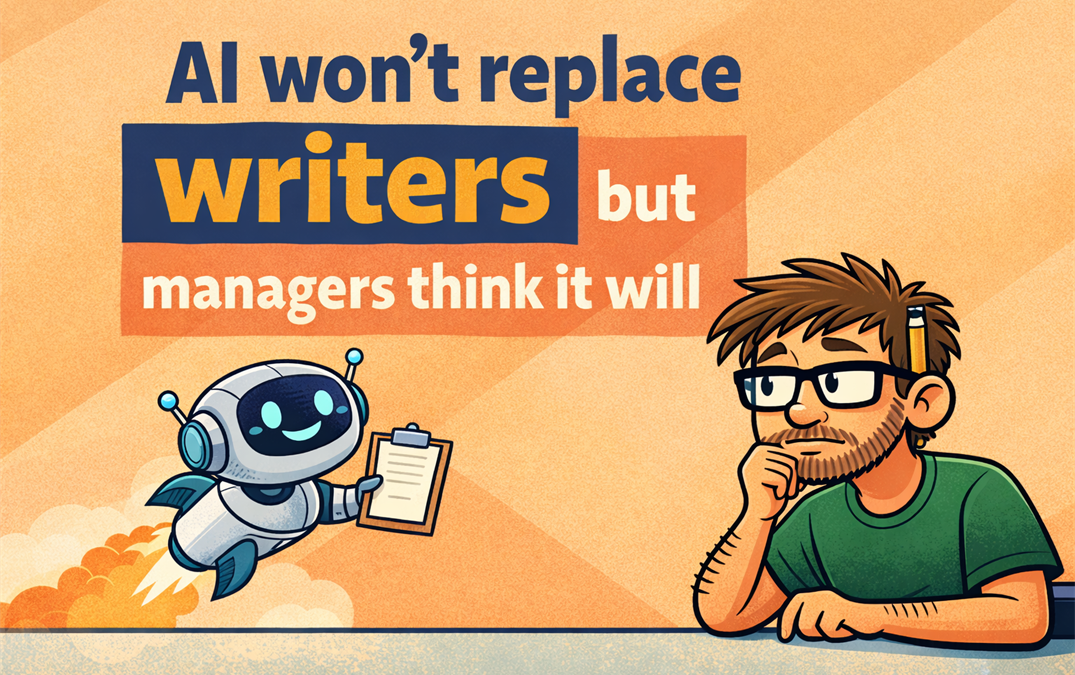
AI won’t replace writers but a surprising number of managers think it will
I have spoken before about the idea that AI will replace writers so I won’t bore you again right now.
But there’s another angle to this argument, one that’s potentially more damaging to the industry.
Writers are mostly fine. We’ve been through the five stages already. Denial. Mild dread. Aggressive experimentation. Obsessive optimisation. Calm acceptance.
We’ve tested the tools, built workflows, argued about prompt phrasing like it’s a wine tasting note and quietly integrated AI into the boring parts of our daily lives.
Meanwhile, somewhere in a boardroom, a spreadsheet is glowing.
Because from a distance, writing looks like output. Words in. Words out. Time spent. Invoice attached.
And if a machine can produce 1,200 words in ten seconds, someone inevitably asks the question with the confidence of a person who has never stared at a blank page for forty minutes:
“Why are we paying writers again?”
You can almost hear the budget line trembling.
The misunderstanding is structural
Most managers aren’t villains twirling moustaches while deleting creative departments.
They’re under pressure. Reduce costs. Increase visibility. Maintain momentum. Deliver quarterly results.
And now there’s a tool that promises efficiency at scale.
It’s seductive.
AI doesn’t ask for revisions. It doesn’t get tired. It doesn’t push back on a weak brief. It doesn’t send polite but pointed emails asking what the actual objective is.
It just produces.
And if your definition of writing is production, then yes, it looks replaceable.
But writing, real writing, has never been about production. It’s about decisions.
Decisions about emphasis. About tone. About what not to say. About which argument deserves oxygen and which should quietly die in the draft folder.
Those decisions don’t show up on a word count. They also don’t show up on the spreadsheet.
Writers adapted faster than leadership
Spend five minutes in a room with serious content creators and you’ll hear a surprisingly pragmatic tone.
- “AI speeds up research.”
- “AI is great for outlining.”
- “AI helps me test angles.”
- “AI gets me unstuck when my brain decides to unionise.”
Writers aren’t pretending AI doesn’t exist. We’re using it. We’re shaping it. We’re treating it like a junior collaborator who’s fast but needs supervision.
Because we understand something instinctively, that AI is very good at average.
Average structure. Average phrasing. Average synthesis of widely available information.
It’s a brilliant aggregator. It’s a competent mimic. It can replicate the centre of the distribution curve with impressive consistency.
But brands don’t grow from the centre of the curve and authority doesn’t emerge from statistical probability.
It comes from perspective. From taking a stance. From saying something that feels considered rather than assembled.
That’s the gap managers sometimes miss. They see speed. Writers see sameness.
The “good enough” illusion
Let’s talk about the phrase that quietly erodes standards.
“Good enough.”
AI output is often good enough. Grammatically clean. Logically structured. Reasonably informative.
It ticks boxes. It fills pages. It keeps the content calendar moving.
And if the goal is volume, good enough feels efficient.
But here’s the longer-term effect.
When every competitor has access to the same models trained on the same corpus of internet knowledge, the median output converges.
Tone flattens. Insights cluster. Headlines start to resemble each other in that uncanny way where nothing is technically wrong but nothing feels memorable either.
You don’t notice the decline immediately. Traffic might even hold steady for a while.
What slips is differentiation.
Writers who work with AI can move faster without sacrificing distinction.
Writers who are replaced by AI remove the friction that produces originality in the first place.
Friction is inconvenient. It slows meetings down. It prompts uncomfortable questions about positioning. It forces clarity.
It also prevents mediocrity.
From the writer’s side of the desk
Let me be blunt in a calm, coffee-fuelled way.
If a company can replace a writer with AI and genuinely see no difference, that writer was being used as a typing service.
That’s not an insult to writers. It’s a diagnosis of the role.
If you’re hired to expand bullet points into paragraphs, yes, a model can probably do that.
If you’re hired to rephrase existing ideas into SEO-friendly formats without adding strategic thought, automation is coming for that slice of the pie.
But if you’re shaping narrative direction, aligning content with business goals, spotting weak logic before it becomes a public embarrassment and building a consistent voice that compounds over time, you’re not competing with a text generator.
You’re operating at a different layer.
AI can simulate authority but it can’t assume responsibility for it, and responsibility is what real content carries.
When something lands badly, when messaging misses the mark, when tone feels off in a sensitive moment, the model doesn’t join the emergency call.
A human does.
Managers aren’t wrong. They’re incomplete
Here’s where I’ll defend leadership for a moment. Just for a moment.
They’re right to explore efficiency. They’re right to question costs. They’re right to rethink workflows as pretending nothing has changed would be negligent.
What’s incomplete is the assumption that writing equals words.
Writing at scale inside an organisation is strategic infrastructure. It influences perception, trust, positioning and long-term growth.
It shapes how a brand sounds when no one is in the room explaining it.
If you reduce that to output volume, you reduce the brand to noise.
The smarter move is redesign, not replacement.
Redesign the workflow so AI handles groundwork. Research summaries. First-pass outlines. Data clustering. Variant generation.
Then let humans handle interpretation. Direction. Refinement. Risk assessment. Emotional nuance. Context.
That model doesn’t eliminate writers, it elevates them.
Which, admittedly, requires a more thoughtful management approach than simply deleting a budget line.
What this really means for writers
If you’re reading this as a creative and feeling slightly smug, pause.
AI will not replace writers, but it will replace writers who refuse to evolve beyond production.
The market is shifting toward judgment, taste and strategic thinking. Toward people who can see the bigger picture and shape content strategies rather than isolated posts.
You can no longer hide behind being “good with words.” The bar has moved. Words are abundant now.
What’s scarce is insight. What’s scarce is clarity under pressure.
What’s scarce is the ability to translate business goals into narratives that resonate with real humans.
If you cultivate that, AI becomes an amplifier. If you don’t, it becomes a competitor.
That’s uncomfortable but it’s also energising.
Will AI replace writers?
No.
But it will expose shallow roles, lazy briefs and organisations that never fully understood what they were paying for in the first place.
It will also reward writers who lean into strategy, perspective and editorial courage.
And managers who learn the difference between generation and authorship will build faster, sharper teams while everyone else publishes a steady stream of competent, forgettable content.
The machine is not the threat.
Complacency is.
And the good news is that complacency, unlike AI, is entirely within our control.
If you’re looking for content that’s more craft than ‘fine’, I am here to help.