Chaining AI prompts the editorial way: Why small steps beat the mega prompt
Let me confess something before we get rolling. I used to chase the mythical One Prompt To Rule Them All.
I’d sit there crafting a paragraph so crammed with instructions that even Tolkien would raise an eyebrow.
Tone rules, structure rules, phrases to avoid, phrases to include, invisible hand gestures, the whole kitchen sink.
And what happened?
Mess. Beautiful, poetic mess, but a mess all the same.
So today we talk about chaining AI prompts. Not as a technical trick, but as the editorial habit your writing brain already understands.
Think of it as line editing for robots, only with fewer coffee stains.
Why chaining AI prompts makes life easier
Picture this. You ask your AI to write a full article, nail the jokes, keep your banned words out, follow your tone, honour your keyword targets, maintain structure, and somehow remember that you like punchy transitions.
That is a lot of cognitive juggling for a machine that will happily write a dissertation about hedgehogs if you let it.
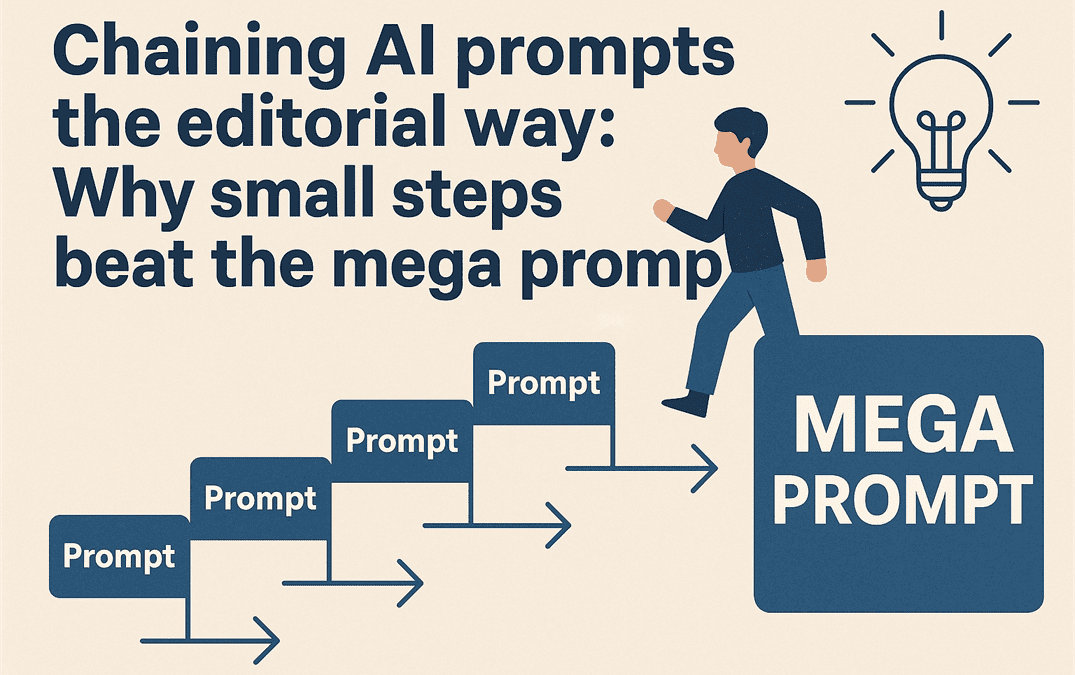
Now try prompt chaining:
- One step: Write the messy draft.
- Next step: Fix the tone.
- Next step: Sharpen the hook.
- Next step: Punch up the jokes.
- Final step: Tidy the bits that look like they were written by a Victorian ghost.
You guide the work the same way you guide a new hire who never gets tired.
This lets you adjust as you go, course correct, experiment and keep human intuition in the loop instead of betting everything on a single Hail Mary prompt.
The creative perks of prompt chaining
Chaining AI prompts fits how writers think.
You wouldn’t hand your editor an entire novel and say, hey, can you correct every single flaw in one sitting while I stand here breathing loudly.
You’d break it into chapters or scenes or problem areas.
Same logic here.
When you chain your AI prompts:
- You get cleaner control of tone, especially when experimenting with humour or invented terms, yes, nanobabble counts.
- You can test variations without blowing up the entire piece.
- You keep your keywords visible without sounding like an SEO tutorial from 2011.
- You stay nimble, since small adjustments feel less like rewriting the universe.
What about the huge complicated prompt method?
It has its place, usually when you need a quick draft and you already know your direction.
But creativity runs into trouble when everything is bundled into one tangled instruction knot.
A big prompt is like asking your AI to write, edit, proof, joke, analyse and interpret telepathy all at once.
It can try, but it starts adding odd little flourishes that make you wonder if it has been reading too much sci-fi.
How to chain AI prompts without overthinking it
Try this simple pattern:
- Draft: Ask for the messy version.
- Shape: Adjust tone, voice, rhythm, pacing.
- Strengthen: Add personality, sharpen jokes, refine arguments.
- Polish: Remove fluff, keep keywords natural, fix stray weirdness.
- Final check: Compare against your intent, not your original prompt.
See, nothing mystical, no sacred ritual, no secret wizard syntax. Just good editorial practice dressed up in AI clothes.
Final thought before I wander off for tea
Chaining AI prompts is a creative partnership. You bring the instinct, judgement and humour, and the AI brings the horsepower.
One complicated prompt asks the AI to be clairvoyant. A chain of smaller prompts lets you steer the ship with a grin and a notebook.
If you’re in the market for content, AI or human-written, I’m your man. Contact me and let’s chat over a coffee.