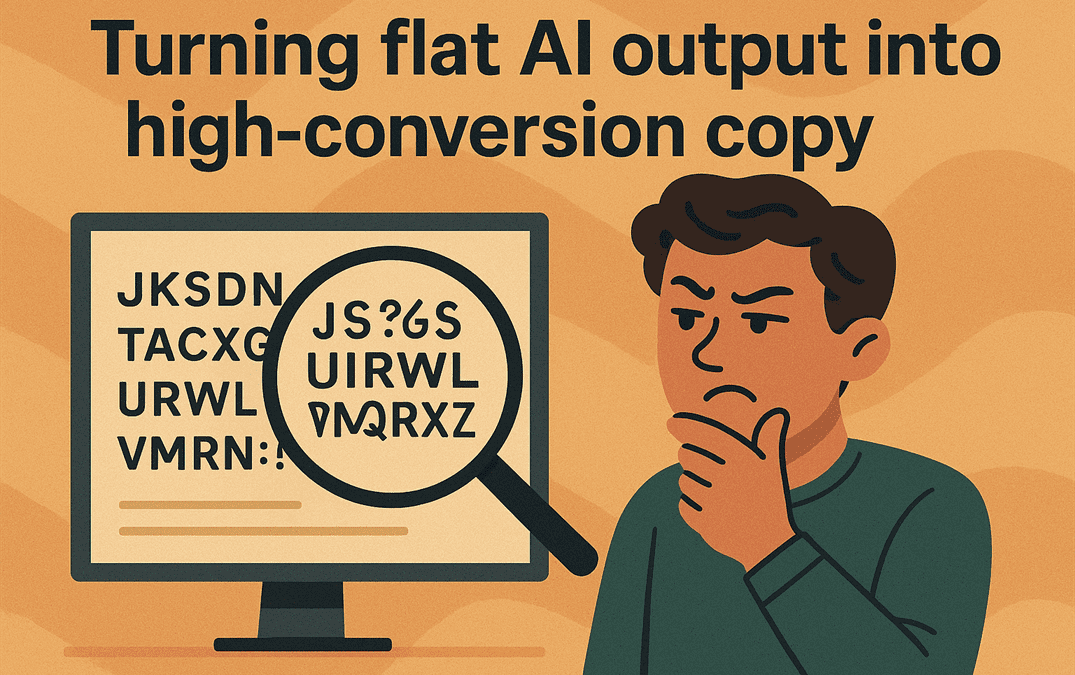
From mechanical to magnetic: Turning flat AI output into high-conversion copy
AI can write perfect sentences that somehow feel like elevator music. Polite. Competent. Completely forgettable.
You paste the output into your editor and it’s grammatically flawless but emotionally vacant. The words exist, but they don’t move.
That’s the core problem with most AI copy. It’s technically right, but spiritually beige.
The fix isn’t to make it more “human” in a vague, coffee shop philosophy way.
It’s to make it more magnetic, words that attract, persuade and convert.
Let’s look at how.
When “technically correct” isn’t persuasive
AI has mastered the language of information, not influence. It can tell you what something does, but not why it matters.
A machine predicts the next logical word. A copywriter predicts the reader’s next emotional reaction.
That gap, the heartbeat between logic and desire, is where conversion lives.
If AI is the engine, you’re the ignition.
Why AI often lacks emotional pull
AI doesn’t feel need, envy, or joy, which means it can describe emotion but never inhabit it.
That’s why it’s copy often sounds like a brochure narrated by an HR chatbot.
The reasons are simple:
- It mimics patterns, not feelings. It can imitate excitement but can’t generate it.
- It avoids risk. To stay “neutral,” AI sands off extremes, controversy and personality.
- It explains instead of persuades. You get content that informs but rarely inspires.
Example:
AI version: “Our platform helps you save time.”
Human rewrite: “Finish your work before lunch and still have time to stretch, snack, or just breathe.”
Same idea, but one has pulse.
Layering persuasion: structure, emotion, and story
Persuasion isn’t decoration, it’s architecture.
I use the P.E.S. model to turn mechanical copy magnetic:
- Proof: Tangible facts, data, or testimonials AI can’t invent responsibly.
- Emotion: Phrasing that mirrors what the reader feels before buying.
- Story: Short human moments that ground abstract promises.
Flat: “This app improves workflow efficiency.”
Magnetic: “Lost in a sea of tabs? Our app keeps everything in one view, so you can finish your work before your next meeting reminder.”
That’s emotional clarity, not embellishment.
Adding specificity and sensory detail
AI loves generalities: “great value,” “easy setup,” “seamless experience.” Humans buy based on specificity.
Try these swaps:
| Mechanical | Magnetic |
| Save time with our app | Reclaim your mornings before email eats them |
| Improve team productivity | Turn scattered effort into smooth momentum. |
| Increase revenue easily | Watch yesterday’s effort earn tomorrow’s profit |
Sensory or situational language is magnetic because it paints a picture reader can feel, not just read.
Testing and refining for conversions
Turning AI output into persuasive copy isn’t one edit, it’s a loop:
Generate → Edit → Emotion check → Test.
Practical checkpoints:
- A/B test AI-edited vs. raw versions. Track clickthrough or sign-up rates.
- Emotion-map your copy and highlight where a reader might feel curiosity, relief, or excitement.
- Feed performance back into AI prompts. “Write with more empathy,” “Emphasise time saved or user benefits, not features.”
This isn’t proving AI wrong, it’s teaching it your brand’s emotional fingerprint.
The voice transfer technique
If you want AI to sound magnetic, give it a voice to learn from.
Take one of your highest-performing human-written pages and prompt AI to “rewrite this topic in the same rhythm, tone and energy.”
That’s voice transfer, not cloning style, but transferring cadence and conviction. It keeps the humanity intact while scaling production.
Using persuasion psychology in prompts
AI improves dramatically when you feed it strategy, not adjectives.
Use behavioural triggers directly in your instructions:
- Social proof: “Include a short customer success example.”
- Authority bias: “Mention endorsement from a credible expert.”
- Loss aversion: “Frame benefit as avoiding frustration or wasted time.”
- Urgency (ethical FOMO): “Encourage prompt action without sounding pushy.”
This blends copywriting psychology with prompt precision, the difference between “helpful content” and “copy that converts.”
From optimisation to emotion
Optimising AI content isn’t about polishing words, it’s about restoring pulse.
Ask yourself:
- Does it make me feel something, interest, curiosity, relief?
- Does it sound like someone talking to me, not at me?
- Could this line exist on a real landing page and make me click?
If not, it’s still mechanical. Your job is to make it magnetic.
Emotional intelligence is the new optimisation
AI can generate sentences. Only humans can generate spark.
Improving AI copywriting isn’t about teaching robots empathy, it’s about lending them ours, through specificity, persuasion and sensory language that speaks to real humans making real decisions.
Because the future of great marketing won’t belong to whoever writes the most words fastest. It’ll belong to whoever makes those words mean something.
And if your AI ever does start writing with true emotion, congratulations, you’ve just automated yourself out of a job and into early retirement!