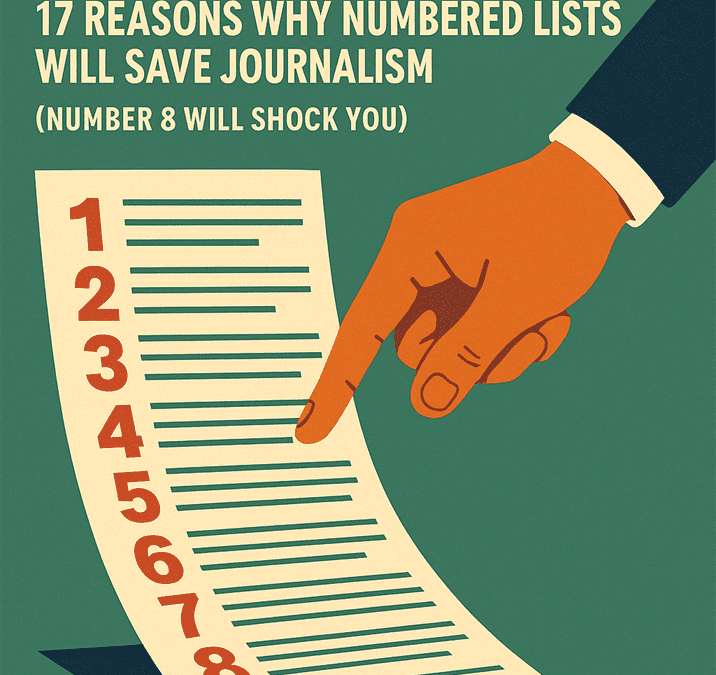
Listicles: 17 Reasons numbered lists will save journalism (Number 8 will shock you)
Ah, the listicle. The internet’s favourite storytelling format, second only to cat memes and angry debates about whether pineapple belongs on pizza.
You know the formula. A bold number in the headline, a vague promise of wisdom, and a sneaky suggestion that one of the items will “shock you.”
Spoiler: it rarely shocks.
Unless you count the shock of realising you’ve just spent ten minutes learning “The 11 Ways to Use Paperclips” when you don’t even own paperclips.
And yet… we click. Every. Single. Time.
Why? Well, let’s break it down. (In a list, obviously. What else did you expect?)
1. Numbers make us feel safe
A headline with a number is like a safety net. It promises structure and closure in a world that otherwise has neither.
“17 reasons” tells you exactly how many dopamine pellets you’re going to get.
It’s not chaos. It’s order, neatly packaged.
It also taps into something primal as our caveman brains love counting things. “Ten commandments.” “Twelve labours of Hercules.” “101 Dalmatians.”
Numbers have been reassuring humanity since the dawn of time. (Except when they’re on a maths exam. Then they’re just cruel.)
2. It tricks our brain into thinking it’s useful
A headline like “How to Be Happier” feels vague. But “7 Ways to Be Happier Before 9am”? That feels practical. Specific. Achievable.
Never mind that the advice is always some variation of “drink water, meditate, stretch, don’t check your phone.”
It feels actionable, so we click.
And yes, you’ll skim it, mutter, “Oh, I should definitely do that,” and then immediately return to doomscrolling X.
But for a brief moment, the list made you believe you were improving yourself. That’s the magic.
3. Lazy writers (like me) love them
Here’s a little secret, writing a listicle is the literary equivalent of microwaving leftovers.
It’s easy, it’s fast, and it works. No transitions, no elegant segues, just stack points like Jenga blocks and call it a day.
That’s why BuzzFeed thrived in the 2010s. Writers could churn out “21 Dogs Who Look Like Famous Politicians” before lunch.
Easy traffic, happy advertisers. (And to be fair, I do want to see a pug that looks like Boris Johnson.)
4. Readers love a skim
Let’s be honest, nobody reads articles online anymore. You skim. You scroll. You look for bold text or numbered points and ignore the rest.
Listicles cater to that.
They give you permission to snack on content instead of sitting down for a five course meal.
Essays guilt-trip you into finishing. Lists say, “Nah, it’s cool if you only read items 2, 5, and 9.”
It’s like a buffet. You pile on chips, skip the salad, and nobody judges you.
5. They’re weirdly addictive
It doesn’t even matter what the topic is. “12 Ways to Use a Paperclip”, sure, why not. “15 Historical Facts About Lighthouses”, okay, I’ll bite.
The more obscure, the better.
You know you don’t need this information, but your brain whispers, “What if number 7 is actually life-changing?”
Spoiler: it never is. But curiosity wins every time.
6. They work on social media
Here’s why you see so many listicles on Facebook, they’re click candy. A headline like “9 Everyday Foods That Are Secretly Killing You” is irresistible.
It’s designed for maximum shareability whether or not the content delivers.
And advertisers love it because more clicks = more eyeballs = more money.
The listicle is the unpaid intern of the internet, overworked, underpaid, but making the whole system run.
7. They’re flexible
Lists can be serious (“10 Signs of a Heart Attack”) or absurd (“17 Hedgehogs Who Look Like Shakespearean Villains”).
They can be short and snappy or long and indulgent. The listicle is like tofu, bland on its own, but it soaks up whatever flavour you throw at it.
That’s why everyone from BuzzFeed to The Guardian uses them. They’re the universal adapter of content.
8. This one will shock you
No, it won’t. But you definitely peeked here first, didn’t you? Admit it. This is the honey trap.
We promise a revelation, you click, and then we reveal nothing at all. (Unless you count this revelation about how we reveal nothing.)
The point is, listicles don’t have to shock you. They just need to suggest they might. And that’s enough to reel us in.
9. They look authoritative
Numbers make things look official. “10 Ways to Improve Your Life” feels like wisdom carved on a stone tablet.
Never mind that the advice is “eat breakfast” and “get more sleep.” It sounds definitive, so you trust it.
That’s why books like “The 48 Laws of Power” and “The 21 Irrefutable Laws of Leadership” sell so well. The list format itself is doing half the work.
It’s like putting on glasses to look smarter in interviews.
10. They’re efficient filler
Not every publisher has groundbreaking insights every week. Sometimes you just need to fill the gap between “real” content.
Enter the listicle. Quick, cheap, reliable. The duct tape of online publishing.
And honestly, would you rather read a rushed 700-word essay, or “11 Ways Your Cat Is Low-Key Judging You Right Now”? Thought so.
11. Humans love categories
We like sorting things. Organising them. Ranking them. Top 10 lists are basically the internet’s version of cave paintings.
We’ve always done it, we just swapped chisels for WordPress.
That’s why people get into heated arguments over lists. “The Top 100 Movies of All Time.” “The 50 Greatest Albums.”
People don’t just read those, they fight over them. And fighting = engagement. Engagement = traffic. Traffic = money. Voilà.
12. They give us permission to stop
Unlike essays or long reads, listicles are designed to be abandoned guilt-free.
Don’t care about points 13 through 17? Fine. Leave.
It’s modular reading. Lists are basically Lego, take the bricks you want, leave the rest in the box.
13. They tap into FOMO
If a headline promises “19 Secrets About Pasta Chefs Don’t Want You to Know,” your brain panics. What if one of those secrets is life-changing? What if you miss out and live a pasta-mediocre life forever?
You click. Because pasta-based FOMO is real.
14. They’re SEO catnip
Google loves lists. They’re easy to parse, easy to rank, and easy to stuff with keywords.
That’s why when you type “best laptops 2025” into Google, you get 14 articles all titled “Top 10 Best Laptops of 2025.”
Search engines practically reward listicles with little digital gold stars. And who doesn’t want gold stars?
15. They’re fun to parody
Listicles are so overdone they’ve become self-aware. Half the fun is mocking them. That’s why this very article exists.
The snake eats its tail, the content becomes about content, and we all nod knowingly like we’re in on the joke.
16. They actually teach (sometimes)
For all my snark, some listicles do deliver. A clever tip here, a handy trick there. They’re like popcorn, mostly fluff, but occasionally you get a kernel of substance that makes it worthwhile.
I once read “15 Ways to Reuse a Mason Jar” and, reader, I reused a mason jar.
Was it life-changing? No. Did I feel like a pioneer of sustainability for 12 minutes? Absolutely.
17. The list is complete
And here we are. The end. The big, satisfying finale. Lists always end neatly, unlike real life, which just sort of meanders on while you wait for your pasta to boil.
But a list? You can check it off. Done. Closure achieved. We crave that neat bow, even if all we’ve really done is read 17 jokes about pasta and binder clips.
The semi-serious point
Listicles are the junk food of content, quick, tasty, rarely filling.
But they work because they fit how we read online, distractedly, hungrily, in quick bites between checking emails and pretending to work.
They’re not journalism’s saviour, but they’re not its downfall either. They’re just… lists.
And we’ll keep writing them, clicking them, mocking them, and secretly enjoying them.